
Every power plant, refinery, and turbomachinery facility depends on more than its major equipment. Gas turbines, steam turbines, compressors, and generators only perform as well as the components supporting them. That’s where specialized engineered products come in precision designed mechanical, electrical, and instrumentation components built to meet exact operating conditions, unlike generic, off the shelf industrial parts.
This guide covers:
- What specialized engineered products are
- The main categories they fall into
- Why these engineered industrial components matter for reliability
- How they differ from general industrial supply
- How to choose the right supplier
1. What Are Specialized Engineered Products?
Specialized engineered products are components designed, manufactured, or selected to meet specific technical requirements that standard parts can’t reliably satisfy. This includes:
- Pressure ratings
- Temperature tolerances
- Material compatibility
- Vibration resistance
- Precision tolerances
Key Characteristics
Unlike general industrial supplies, these custom-engineered parts are typically:
| What It Means | |
| Application-specific | Engineered for a particular type of equipment or process |
| Performance-critical | Failure directly impacts uptime, safety, or efficiency |
| Precision-built | Requires specialized alloys, coatings, or tight-tolerance machining |
| Engineer-selected | Chosen or customized by engineers, not picked from a generic catalog |
2. Categories of Specialized Engineered Products
2.1 Mechanical Components
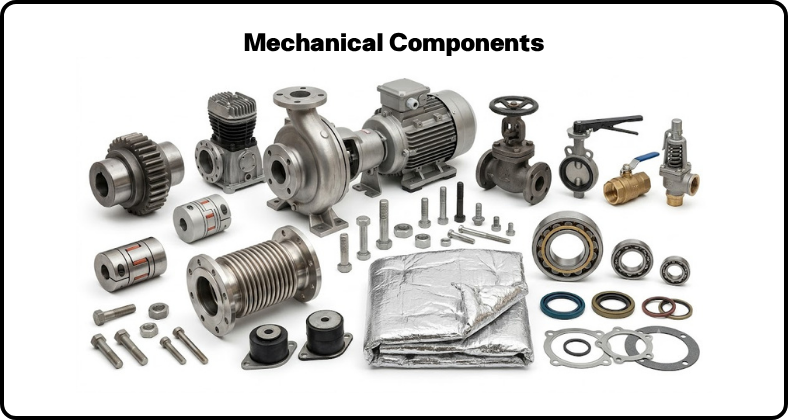
The physical backbone of rotating and static equipment:
- Pumps, compressors, and internal parts
- Flexible and gear couplings
- Special alloy fasteners
- Expansion joints
- Vibration dampers
- Thermal and acoustic insulation
- Valves (globe, butterfly, gate, ball) and pressure relief valves
- Bearings, gaskets, and seals
2.2 Electrical Components
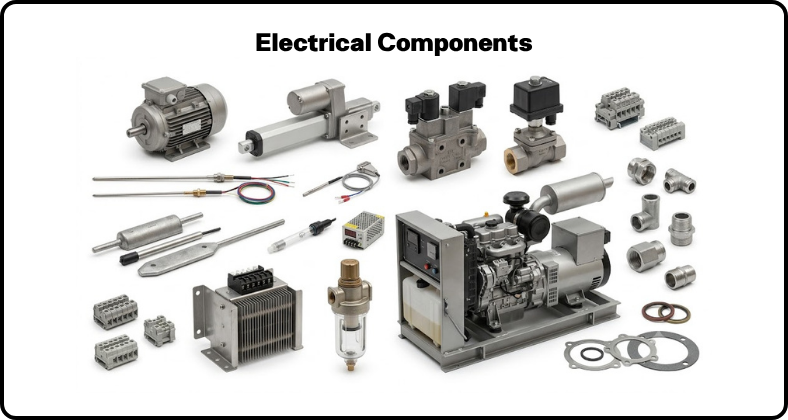
Support systems for control and power delivery:
- Motors and actuators
- EHC (Electrohydraulic Control) valves
- Pulse control valves
- Thermocouples and RTDs
- Cathodic protection systems
- Duct heaters and pneumatic lubricators
- Liquid fuel gensets
2.3 Instrumentation
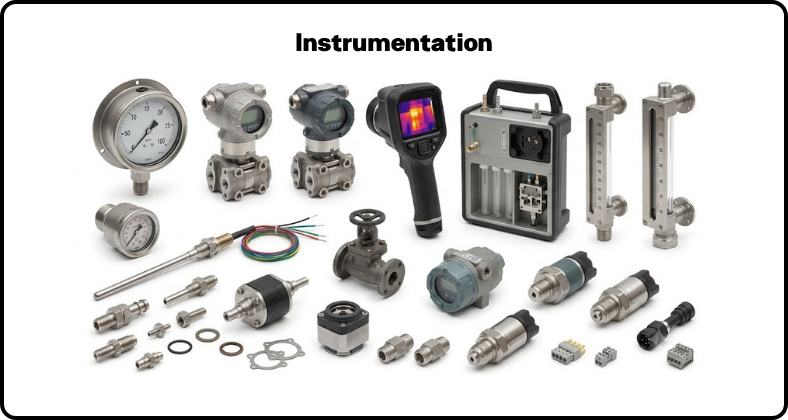
Real-time visibility for plant operators:
- Pressure and level gauges
- Thermal imaging cameras (predictive maintenance)
- DGA (Dissolved Gas Analysis) equipment
- Process sensors
3. Why Specialized Engineered Products Matter
| Benefit | Why It Matters |
| Reliability & uptime | A single failed gasket, seal, or valve can trigger costly unplanned downtime |
| Energy efficiency | Correctly engineered insulation and rotating components reduce energy losses |
| Safety | Pressure relief valves, cathodic protection, and EHC valves prevent catastrophic failures |
| Compliance | Utilities, petrochemicals, and aerospace require parts meeting strict industry standards |
| Cost savings | Higher upfront cost, but lower total cost of ownership through fewer failures |
4. Specialized Engineered Products vs. General Industrial Supply
| General Industrial Supply | Specialized Engineered Products | |
| Definition | Broadly available parts used across industries | Components built or selected for a specific application |
| Examples | Common fasteners, standard pipes, generic gauges | Alloy fasteners for corrosion resistance, valves rated for exact pressure ranges |
| Risk if misapplied | Low for general use | High, as using a generic part in a specialized application is a leading cause of premature equipment failure |
5. How to Choose a Supplier
Look for a partner that offers:
- Engineering expertise: Not just a parts catalog
- Cross category coverage: Mechanical, electrical, and instrumentation in one place
- Industry specific experience: Utilities, oil & gas, petrochemicals, aerospace
- Global support: Fast turnaround when components fail unexpectedly
- Proven track record: Established history in power generation and turbomachinery
Conclusion
Specialized engineered products are the unsung components behind reliable, efficient, and safe power generation and turbomachinery operations. Choosing the right engineered industrial components and the right partner to source them from can mean the difference between a plant that runs smoothly for decades and one plagued by unplanned downtime.
Looking for specialized engineered products backed by real engineering expertise? Contact ATTS Inc. to discuss your project’s requirements.
Frequently Asked Questions
1. What is the difference between specialized engineered products and standard industrial parts?
Standard parts are mass-produced for general use; specialized engineered products are built or selected for specific pressure, temperature, material, or tolerance needs.
2. Which industries use specialized engineered products the most?
Power generation, utilities, oil & gas, petrochemicals, aerospace, and telecom, due to their high-stress equipment demands.
3. Are specialized engineered products more expensive than generic parts?
Often higher upfront, but they lower total cost of ownership through better reliability and longer lifespan.
4. Can specialized engineered products be customized for a specific plant or application?
Yes — many suppliers offer custom engineering to match exact operating conditions and requirements.
5. How do I choose the right supplier for specialized engineered products?
Look for engineering expertise, cross-category experience, sector knowledge, and reliable global support.
Don’t Let a Missing Component Cause Downtime.
ATTS Inc. delivers specialized engineered products with the reliability and global support power plants depend on. Request a quote today.