
Industry: Power Generation & Industrial Engineering
Solution: EHC Valve Rehabilitation
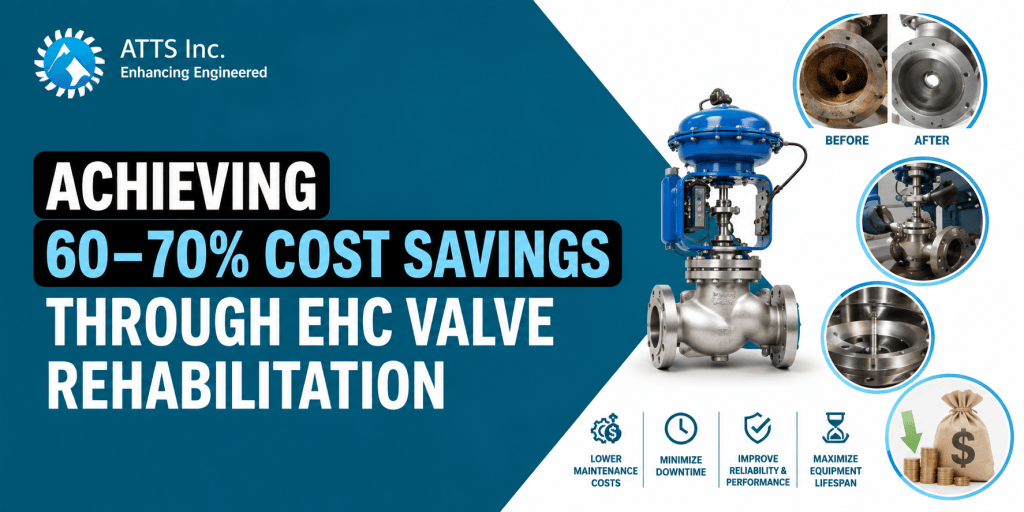
Key Result: 60–70% Cost Savings Compared with New Valve Procurement
Case Study Overview
Electro-Hydraulic Control (EHC) valves are critical components in power generation and industrial systems, where reliable control and continuous operation are essential. Over time, demanding operating conditions can cause wear, contamination, and component degradation, creating the need for maintenance or replacement.
For many facilities, replacing an entire EHC valve can be expensive and may involve extended procurement timelines. ATTS Inc. addressed this challenge through a specialized EHC valve rehabilitation program, providing an alternative to complete replacement.
By inspecting, refurbishing, repairing, and testing existing valves, the program helped customers achieve 60–70% cost savings compared with purchasing new valves.
The Challenge
EHC valves operate under demanding conditions and must maintain consistent performance to support reliable plant operations. When valve components become worn or damaged, operators can face increased maintenance costs and potential operational disruption.
Complete replacement can also present additional challenges, including:
- High procurement costs
- Long lead times for specialized valves
- Difficulty sourcing aging or obsolete components
- Increased maintenance budgets
- Potential delays in returning equipment to service
The customer therefore needed a solution that could restore suitable EHC valves while reducing the financial and operational impact associated with full replacement.
The ATTS Solution
ATTS developed a rehabilitation approach focused on restoring existing EHC valves rather than automatically replacing them.
The process begins with a detailed inspection to evaluate the valve’s condition and identify components requiring repair or replacement. Suitable components are retained where possible, while damaged or worn parts are refurbished or replaced.
The rehabilitation process included:
- Inspection & Assessment:
Each valve was evaluated to identify wear, damage, contamination, and other potential issues. - Disassembly & Cleaning:
The valve was carefully disassembled and cleaned to enable detailed examination of individual components. - Component Evaluation:
Parts were assessed to determine whether they could be reused, repaired, or required replacement. - Refurbishment & Repair:
Required components and surfaces were restored or replaced to return the valve to the required operating condition. - Testing & Verification:
After reassembly, the valve underwent appropriate functional and quality checks before being returned to service.
This approach allowed the customer to make use of existing equipment while avoiding the cost of complete replacement where rehabilitation was technically appropriate.
The Results
The most significant outcome was the financial benefit delivered through rehabilitation.
60–70% Cost Savings
Compared with purchasing new EHC valves, the rehabilitation program achieved approximately 60–70% savings.
For industrial facilities managing multiple critical valves, this represents a significant opportunity to reduce maintenance expenditure while extending the useful life of existing assets.
Beyond cost savings, the approach provided customers with a practical alternative for managing aging or difficult-to-source equipment.
Key benefits included:
- 60–70% lower cost compared with new valve procurement
- Extended usability of existing EHC valve assemblies
- Reduced dependence on complete equipment replacement
- Greater flexibility in maintenance planning
- Better utilization of existing industrial assets
- A cost-effective approach to equipment lifecycle management
Why EHC Valve Rehabilitation Matters
For critical industrial facilities, maintenance decisions involve more than simply choosing between repair and replacement. Operators must consider reliability, cost, availability, lead time, and remaining asset life.
Where an EHC valve is suitable for refurbishment, rehabilitation can provide a practical middle ground. Instead of replacing an entire assembly, maintenance teams can restore the components that require attention and continue using the existing equipment.
ATTS’s approach demonstrates how specialized engineering and refurbishment can help customers make informed maintenance decisions while controlling lifecycle costs.
Frequently Asked Questions
1. What is EHC valve rehabilitation?
EHC valve rehabilitation involves inspecting, repairing, refurbishing, and testing an existing Electro-Hydraulic Control valve to restore it to an appropriate operating condition.
2. How much can EHC valve rehabilitation save?
ATTS’s published case study reports approximately 60–70% cost savings compared with new valve procurement.
3. When should an EHC valve be rehabilitated?
Rehabilitation can be considered when the existing valve is technically suitable for restoration and its components can be effectively repaired or replaced following a professional assessment.
4. What does the rehabilitation process involve?
It can include inspection, disassembly, cleaning, component evaluation, repair or replacement, reassembly, functional testing, and quality verification.
5. What are the main benefits?
The primary benefits are lower maintenance costs, extended asset life, reduced replacement requirements, and greater maintenance flexibility.
Conclusion
ATTS’s EHC valve rehabilitation program demonstrates that complete replacement is not always the only solution for aging or damaged industrial equipment.
By combining technical inspection, refurbishment, component replacement, and testing, ATTS helped customers achieve 60–70% cost savings compared with new valve procurement while making better use of existing assets.
For organizations looking to control maintenance expenditure without unnecessarily replacing critical equipment, EHC valve rehabilitation can provide a practical and cost-effective lifecycle solution.