

Why clean-looking turbine oil can still threaten bearings, control valves, and plant reliability, and how proper oil condition monitoring helps prevent expensive equipment failures.
You check the oil report, and everything looks fine. Particle counts are in range, the oil is clear, and the filters are working. Yet a servo valve is still sticking.
The reason is simple: clean turbine oil isn’t always healthy oil. Oil can pass a visual check and a particle count, while oxidation, depleted additives, and early varnish are already building up inside bearings and control valves.
Routine checks measure cleanliness, not condition. That gap is where problems hide, and closing it with proper oil condition monitoring helps you act before damage or unplanned downtime.
01. The Hidden Problem
When the Oil Report Looks Good but the Equipment Doesn’t
Most industrial plants monitor turbine oil through routine sampling, visual inspections, and particle counting. These methods provide useful information, but each has limitations.
 | Visual Inspection Oil may look clean even when dissolved degradation products or depleted additives are affecting its condition. |
 | Particle Counting Counts identify suspended contamination but do not directly measure chemical degradation or remaining antioxidant protection. |
 | Conventional Filtration Standard filters remove particles per their specifications, but may not eliminate dissolved varnish precursors or restore depleted additives. |
A Failure Scenario
The filters were working. The control valve was still sticking.
Consider a gas turbine operating with acceptable particle counts and no visible contamination in its oil reservoir.
Over several months, oxidation products gradually accumulate. Some remain dissolved while the oil is hot but form deposits as temperatures change.
Eventually, a servo valve begins responding inconsistently. Maintenance technicians inspect the filtration system and find nothing unusual.
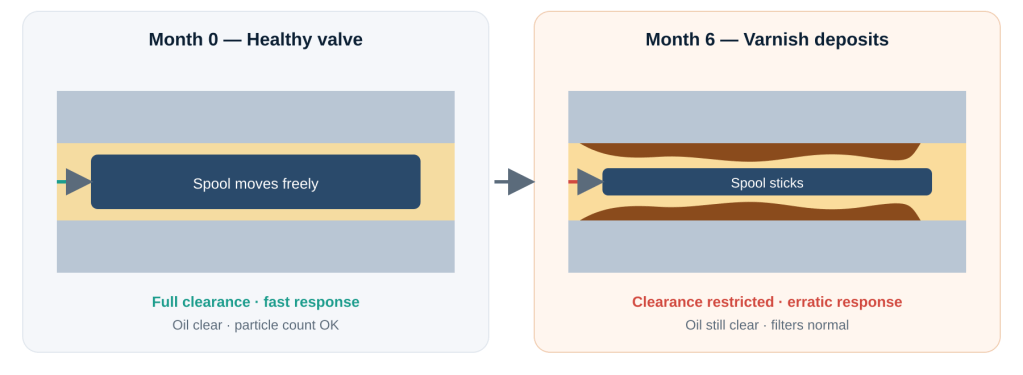
The issue is not necessarily conventional particle contamination. Varnish deposits may be interfering with the valve’s internal clearances.
If the underlying condition remains unresolved, control response can deteriorate and increase the risk of an unplanned shutdown.
02. Understanding Oil Degradation
Not Every Oil Problem Can Be Filtered Away
Lubricating oil changes chemically throughout its operating life. Heat, oxygen, moisture, and operating conditions can accelerate degradation even when filtration equipment continues removing particles.
Three conditions deserve particular attention.
01. Varnish Formation
As turbine oil oxidizes, degradation products accumulate. When these materials become insoluble, they can form deposits on bearings, valve components, and other internal surfaces.
These deposits may restrict movement, affect control response, and create reliability problems.
02. Moisture Contamination
Water can enter lubrication systems through condensation, damaged seals, or cooling equipment leaks.
Excessive moisture can encourage corrosion, contribute to oil degradation, and reduce the reliability of lubricated components.
03. Additive Depletion
Turbine oils contain antioxidants and other additives designed to protect lubricant performance.
These additives gradually deplete during operation. Oil may still appear normal even when its resistance to further oxidation has decreased.
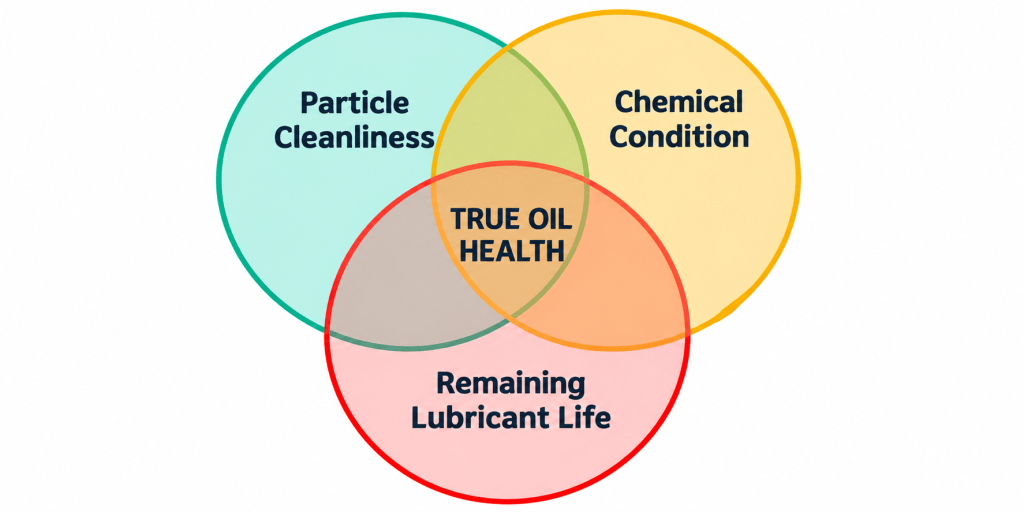
The critical distinction is that particle cleanliness, chemical condition, and remaining lubricant life are separate measurements.
A reliable maintenance strategy considers all three.
03. The Overlooked Part
Testing Oil Is Easy. Interpreting the Results Takes Expertise.
Oil analysis generates measurements. Effective maintenance depends on understanding what those measurements mean together.
A rising varnish potential result does not automatically justify oil replacement. A low particle count does not guarantee healthy lubrication. One abnormal reading may require further investigation rather than immediate intervention.
The important part is identifying trends and connecting laboratory findings with equipment behavior.
| Icon | Assessment | What it tells you |
 | Particle Counting (ISO 4406) | Measures suspended particle contamination and helps evaluate oil cleanliness. |
 | Membrane Patch Colorimetry (ASTM D7843) | Assesses insoluble degradation products associated with varnish potential. |
 | RULER Antioxidant Testing | Evaluates remaining antioxidant levels against an appropriate reference. |
 | Moisture Analysis | Identifies water contamination that may affect lubricant condition and equipment performance. |
 | Acid Number and Viscosity Testing | Helps identify chemical and physical changes in the lubricant. |

Conceptual illustration, not measured data.
04. A Better Approach
Improve Oil Condition Before Problems Reach the Equipment
When oil degradation is detected, complete replacement is not always the most appropriate first response.
The right decision depends on contamination levels, chemical condition, remaining additive protection, and equipment requirements.
ATTS provides specialized lube oil monitoring and conditioning solutions that help industrial facilities assess lubricant health and determine suitable corrective action.
What ATTS Brings Together
01. Oil Condition Monitoring
Particle counting, Membrane Patch Colorimetry, and RULER testing provide information about cleanliness, varnish potential, and antioxidant condition.
02. Varnish Filtration
Specialized conditioning technologies help address degradation products that conventional particle filters may not effectively remove.
03. Oil Purification and Dehydration
Filtration and dehydration systems help control particulate contamination and moisture within industrial lubrication systems.
04. Oil Life Extension
Where oil condition permits, appropriate treatment may extend useful lubricant life and reduce unnecessary replacement.
05. Maintenance Decision Support
Combining oil analysis with equipment history helps teams determine whether to continue monitoring, condition the lubricant, investigate components, or plan replacement.
The objective is not simply cleaner oil. It is maintaining lubricant performance while protecting critical equipment.
05 – FAQs
- Can turbine oil be unhealthy even when it looks clean?
Yes. Clear oil may contain dissolved degradation products, excessive moisture, or depleted additives. Visual inspection alone cannot confirm lubricant health. - What causes varnish in turbine lubrication systems?
Varnish develops from lubricant degradation, commonly associated with oxidation and thermal stress. Insoluble degradation products can accumulate on internal surfaces. - Can standard oil filters remove varnish?
Conventional filters primarily target suspended particles. Dissolved varnish precursors may require specialized conditioning technologies. - Can turbine oil be restored without replacement?
Sometimes. Filtration, dehydration, and varnish mitigation may improve specific oil conditions. Severely degraded lubricant may still require replacement. - How frequently should turbine oil be tested?
Testing intervals depend on equipment criticality, operating conditions, oil history, and manufacturer recommendations. Abnormal trends may justify more frequent sampling.
Talk to an Engineer
Healthy Oil. Reliable Equipment. Fewer Surprises.
A clean particle count is useful, but it does not reveal everything happening inside a turbine lubrication system.
Backed by 28+ years of engineering expertise, ATTS helps power generation, oil and gas, and industrial facilities monitor oil condition, control contamination, and make informed maintenance decisions before lubrication problems threaten equipment reliability.
Explore Lube Oil Monitoring & Conditioning Solutions
ATTS INC | 1930 EAST MARLTON PIKE, BUILDING Q, CHERRY HILL, NJ 08003 | SALES@ATTS-INC.COM | +1-856-810-0006